HSK 3.0 Writing Tasks by Level
HSK 3.0 writing starts at Level 2. The samples name the section 书写, then 写作, and printed character minimums run from 80 characters to 600.
By Chinese CopilotLast reviewed ≈18 min read
On this page
Writing on the HSK 3.0 samples starts at Level 2. The Hanyu Shuiping Kaoshi (HSK) Level 1 cover, HSK/HSK(一级)样卷.pdf in the official sample ZIP, is two parts and 40 items: listening and reading. It has no 书写 heading and no 写作 heading. Level 2 is the first cover that adds a writing block, and that block is named 书写, 10 items and 10 minutes, not 写作. Level 3 keeps the name 书写, 10 items and 20 minutes. From Level 4 the cover name is 写作. Character minimums begin on that Level 4 paper, at 80 Chinese characters (字) for one short text, and the longest minimum in the set is 600 characters on the Levels 7-9 topic essay. The steps between those two numbers are not a steady climb.
The covers were compiled by 中外语言交流合作中心, the Center for Language Education and Cooperation (CLEC). CTI Co., Ltd. (CTI) links the ZIP from the HSK overview under the download name HSK3.0考试样题.zip. File names, the 书写 and 写作 rows, and the task lines below are from that set. HSK 3.0 Sample Papers: What Is in the Set is the file list. HSK 3.0 Exam Format: Questions and Timing keeps the listening, reading, speaking, and translation ladder. This page stays on writing.
Level 1's cover stops at listening and reading. The writing row begins at Level 2, and the printed name changes at Level 4.
On 20 October 2026, a search for "hsk 3.0 writing section" still turned up writing as a column or a one-line summary, not as a paper-by-paper task page. Zizzle's HSK 3.0 guide puts writing inside a Levels 1-6 format section and gives one line of task types. Shangke's HSK 3.0 page groups Levels 2 and 3 as filling in a character and stops the writing note at Level 4's 80 characters. PrepEdu's structure post says character writing starts at HSK 2 and lists item totals. It does not walk item ranges. Pass HSK's Level 3 requirements page describes communicative tasks, not sample items 61-70. Vision Chinese's writing guide says it covers the paper in use before December 2026, and that HSK 3.0 starts on 13 December 2026. This site's format post already had the writing column and a Level 4 to Level 6 minima figure. None of those pages keeps the sample task ranges, the 书写 / 写作 rename, the Level 2 answer key's 54-63 numbering, the printed per-task minutes only at Levels 7-9, and the handwriting lists as a syllabus object the Level 1 paper does not use.
书写 on two papers, 写作 from Level 4
Level 2 and Level 3 print a divider, 下面是书写部分, and the line 请在书写考试开始后作答. The section heading is 三、书 写. Level 4 and every later written sample print 下面是写作部分 and 三、写 作. The rename is on the cover row as well: 书写 for the first two writing papers, 写作 from Level 4 through Levels 7-9. It is not two names for one continuous item sequence. Level 2's writing items are 51-60. Level 3's are 61-70. Level 4 starts again at 65.
Under 书写, the work is still a character or a sentence built from a given word. Level 2 items 51-55 ask for a component. Items 56-60 ask for one character in a blank. Level 3 items 61-65 ask for one character inside a sentence, with a pronunciation cue over the blank. Items 66-70 ask for a sentence from a given word. There is no 看图 on that Level 3 page. Zizzle's one-line summary calls Level 3 "picture-prompted sentences." The sample does not. The picture instruction arrives at Level 4: 第 65~69 题:看图,用词造句.
The six component letters are listed on the Level 2 guide. The Level 3 guide walks the sentence task and does not copy the 参考答案 sentences. How a character differs from a word is Chinese characters vs words. This page keeps the comparison.
书写 is the Level 2 and Level 3 heading. 写作 starts at Level 4. Item numbers restart with each paper.
What each sample asks you to write
The table is the writing row and the writing items only. Listening and reading counts live on the format post. "Not split" means the cover prints one block of minutes and the item lines do not add a 限时 of their own.
| Level | Cover row | Items | Minutes on the cover | Task on the paper | Floor in 字 |
|---|---|---|---|---|---|
| 1 | no writing section | none | none | listening and reading only | none |
| 2 | 书写, 10 items | 51-55, then 56-60 | 10, not split | a component, then one character | none |
| 3 | 书写, 10 items | 61-65, then 66-70 | 20, not split | a character in a sentence, then a sentence from a word | none |
| 4 | 写作, 6 items | 65-69, then 70 | 25, not split | picture sentences, then a short text | 80 on item 70 |
| 5 | 写作, 2 items | 71, then 72 | 40, not split | a picture story, then a topic | 100, then 200 |
| 6 | 写作, 2 items | 81, then 82 | 45, not split | a practical text, then a topic | 150, then 300 |
| 7-9 | 写作, 2 items | 81, then 82 | 55, split on the items | a chart, then a topic essay | 200 in 15 minutes, then 600 in 40 |
Level 1 is the guide's "no writing section". The cover's first note is 分两部分,共 40 题, listening and reading. The whole paper is about 40 minutes, including 5 minutes for personal information. Nothing in that note is a writing part.
Level 2's cover says 分三部分,共 60 题, and part 3 is 书写(10 题,10 分钟). After the divider, 第 51~55 题 offers six components labeled A through F. The example box is marked E. The Level 2 guide lists the six components and the example word. 第 56~60 题 fills one character. The example is 你想喝茶还(是)喝咖啡?, so the character in the example blank is 是. The paper's writing items stop at 60.
The Level 2 answer key, HSK/HSK(二级)样卷答案.pdf, does not use 51-60 for that block. Under 三、书 写, the first part is numbered 54 through 58 and gives letters (54 B, 55 D, 56 C, 57 A, 58 F). The second part is numbered 59 through 63 and gives characters: 的, 可, 好, 学, 洗. This page follows the paper's 51-60. It does not renumber the key. The key prints no full score and no pass mark for the block.
Level 3's cover says 书写(10 题,20 分钟). 第 61~65 题 puts a pronunciation cue over a blank in a sentence. The example cue is dǎ and the character is 打, in 咱们一会儿(打)车回家吧. 第 66~70 题 gives a word and asks for a sentence. The example word is 开心, and the paper shows 他开心得跳起来了. The five words on the items are 羽毛球, 饱, 爬, 结婚, and 地图. No item in that part says 看图. The answer key prints one character each for 61-65 and labels 66-70 参考答案. Those sentences are not copied here. The key does not attach a score, a pass mark, or a rubric to them. The sentence-level walk-through stays on the Level 3 guide.
The floors are the 字 counts printed on the items. Level 6's 150 sits after Level 5's 200. The 7-9 chart's 200 sits after Level 6's 300.
Level 4's cover says 写作(6 题,25 分钟). The 25 minutes are one block. 第 65~69 题:看图,用词造句. 第 70 题:写短文. The item line is 请写一篇不少于 80 字的短文,介绍一下你最难忘的一次旅行. The answer key prints a 参考答案 sentence for each of 65-69 and marks the second part 略. The five sentences are not copied here, and 略 means the key does not print a model for the 80-character text. No score or rubric is printed with either part. Pictures, the five given words, and the short-text line are walked in the Level 4 guide.
Level 5's cover says 写作(2 题,40 分钟). The 40 minutes are not divided on the cover or on the items. 第 71 题:看图写作 asks for a story from four pictures about 李明 and his companions, 不少于 100 字. 第 72 题:话题作文 asks for an attempt you have made and how it felt, 不少于 200 字. The answer key marks 71 and 72 略. The full prompts are on Level 5, items 71 and 72.
Level 6's cover says 写作(2 题,45 分钟). Again the minutes are one block. 第 81 题:应用文写作 is a rental notice for a two-bedroom flat and a roommate, 不少于 150 字. 第 82 题:话题作文 asks whether scientific development promotes or limits a person's all-round development, 不少于 300 字. The key marks 81 and 82 略. The prompts are on Level 6, items 81 and 82.
No sample answer key read for this page prints a writing rubric, a full score for the writing section, or a pass mark. Where a key says 略, it is withholding the model text. Where a key says 参考答案, it is still not a published score.
One clock, except at Levels 7-9
Levels 2 through 6 print writing minutes once, on the cover row in the table above: 10, 20, 25, 40, and 45. No item line on those papers adds 限时. The 25 minutes at Level 4, the 40 at Level 5, and the 45 at Level 6 are section totals. They are not a separate clock for the short text, the picture story, or the rental notice.
Levels 7-9 are the exception, and only there. The cover still says 写作(2 题,55 分钟). The items then print 限时 15 分钟 and 限时 40 分钟. 15 + 40 = 55, so the item clocks add up to the cover row. They are not an extra 55 minutes on top of the cover.
The 5 minutes for personal information, printed on the Level 1 through Level 6 covers inside the whole-paper total, is not a hidden piece of the writing row. On the Level 3 sample the writing row itself says 20 minutes. A table that says 15 minutes for writing is a different writing row, not the sample's 20 with the personal-information line removed. The Levels 7-9 cover read here does not put that personal-information parenthetical on the page. Its whole-paper line is 全部考试约 200 分钟.
Levels 2 to 6 give one writing total. Only the Levels 7-9 items print 15 minutes and 40 minutes.
Levels 7-9: a chart in 15 minutes, then 600 characters
The Levels 7-9 written paper is five parts and 91 items, about 200 minutes on the cover. Writing is part 3. The same cover lists translation as part 4 and speaking as part 5. Those two parts, and the 91-versus-98 comparison with the live English page, stay on What Is HSK 7-9?. That post records the 200-character and 600-character minima and does not quote the prompts. The task lines are quoted here.
第 81 题:请对图表进行描述与分析,写一篇不少于 200 字的文章,限时 15 分钟。 The chart title on the paper is 图:中国健身人群经常去健身房的原因. The item is a description and analysis of that chart, at least 200 characters, limited to 15 minutes.
第 82 题:话题作文,限时 40 分钟。 The prompt quotes 己所不欲,勿施于人 from 《论语》 and glosses it: 指自己不想要的东西或者不愿意承受的事情,就不要施加给别人. It asks whether you agree. Then: 请写一篇不少于 600 字的文章,论证你的观点。 At least 600 characters, 40 minutes, an argument for your view.
The answer key's writing block is 第 81~82 题 and (略). There is no model chart description and no model essay in that key, and no score, pass mark, or rubric beside the 略. Do not treat a practice essay as if a published 3.0 scale had scored it. Nothing read on these samples is that scale.
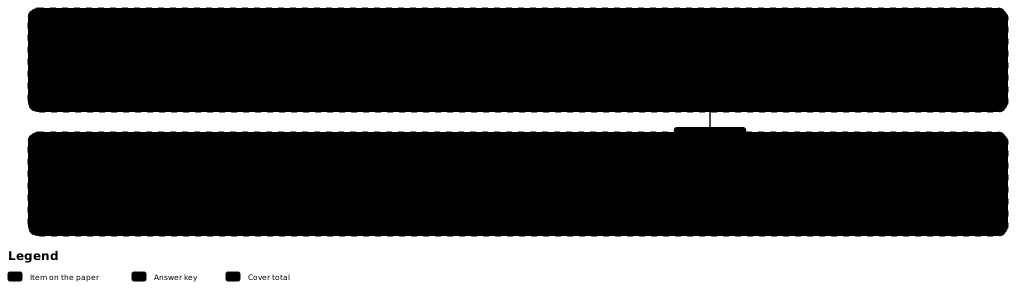
The cover's 55 minutes is the sum of the two printed limits. 略 means the key omits both writing items.
Handwriting lists are not the timed section
The 2025 syllabus PDF, 《中文水平考试 HSK 考试大纲》, prints separate 书写字 lists. They are inventories of characters, not the items on the sample. Cite-line vocabulary totals live in HSK 3.0 by the Numbers. A character you can handwrite and a word you can recognize are different objects, which is the point of Chinese characters vs words.
Each list starts again at 1. The last number on the list is the length of that list. The Levels 7-9 heading in the syllabus uses a dash between 七 and 九. The table prints a hyphen in that one cell.
| Syllabus heading | Last number | First and last entry |
|---|---|---|
| HSK(一级)~(二级)书写字 | 100 | 1. 爱 to 100. 作 |
| HSK(三级)书写字 | 150 | 1. 安 to 150. 总 |
| HSK(四级)书写字 | 150 | 1. 巴 to 150. 座 |
| HSK(五级)书写字 | 150 | 1. 版 to 150. 追 |
| HSK(六级)书写字 | 150 | 1. 岸 to 150. 壮 |
| HSK(七-九级)书写字 | 500 | 1. 挨 to 500. 揍 |
There is no heading that is only Level 2. Levels 1 and 2 share the list of 100. The Level 1 sample still has no writing section. The shared list is in the syllabus. It is not a timed block on that paper. The Level 1 word list is the vocabulary outline, a different list from these 书写字. The Level 2 guide notes that two components on items 51-55 sit outside both the shared handwriting list and the Level 2 recognition list.
Adding the last numbers gives 100, then 250, then 400, then 550, then 700, then 1,200. The arithmetic is 100, 100 + 150 = 250, 250 + 150 = 400, 400 + 150 = 550, 550 + 150 = 700, and 700 + 500 = 1,200. The syllabus does not print those six sums as headings. The 150 on the Level 3 list is the length of that list, because the list restarts at 1. It is not a running total written in the book.
The English Wikipedia HSK article's 2025 table, read on 20 October 2026, puts Level 1 writing characters at 0 and then that same cumulative series, ending at 1,200. Zizzle prints a Level 1 count of 0, a Level 2 count of 100, and those added totals, and captions them as a subset of recognition characters. Pass HSK's Level 3 page prints 250 the same way. Those are not the syllabus headings. Level 1's heading is the shared list of 100, and the Level 1 paper does not test it.
The essay floors are a third number, and they are not these list lengths. 不少于 80 字 on Level 4 item 70 counts characters in the text the candidate writes. The item does not say to use only the Level 4 handwriting list, and the list is not attached to the task. The Levels 7-9 word list is the 5,600 new vocabulary entries, numbers 5,401 to 11,000. It is not the 500-character handwriting list, and it is not the 600-character floor on item 82.
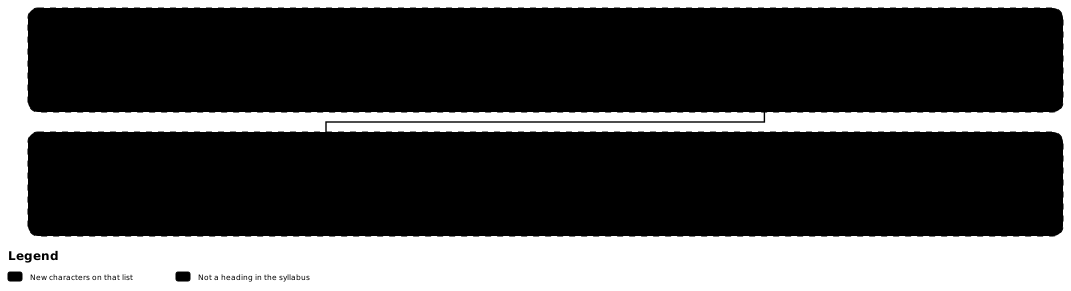
The shared list of 100 covers Levels 1 and 2. Level 1 still has no writing section on the paper. The 1,200 is addition.
English pages, named one document at a time
CTI's English level pages describe a writing section that does not match these samples. Each row names one page, live at that address on 20 October 2026. The pages themselves are not labeled as an older HSK. The five minutes of personal information on the Level 1 through Level 6 covers do not close these gaps. Where the minutes match, the item count does not. Where the item count matches, the minutes or the task text do not.
| Page | Writing on that page | Writing on the 3.0 sample |
|---|---|---|
| Level 2 | no writing row; listening and reading only | 书写, 10 items, 10 minutes |
| Level 3 | two parts, 5 and 5: 10 items, 15 minutes | 书写, 10 items, 20 minutes; a character in a sentence, then a sentence from a word |
| Level 4 | 10 plus 5: 15 items, 25 minutes | 写作, 6 items, 25 minutes; five picture sentences and one text of at least 80 characters |
| Level 5 | 8 plus 2: 10 items, 40 minutes | 写作, 2 items, 40 minutes; at least 100 characters, then at least 200 |
| Level 6 | 1 item, 45 minutes | 写作, 2 items, 45 minutes; at least 150 characters, then at least 300 |
| Levels 7-9 | two subjective parts, 1 and 1: 2 items, 55 minutes; charts, then opinions. No 15/40 split and no 200 or 600 floor on the page | 写作, 2 items, 55 minutes, split 15 and 40 on the items; at least 200 characters, then at least 600 |
The Level 7-9 page's prose for that section is "Description and analysis of charts; express and defend opinions on given topics." It does not print the 15-minute and 40-minute split, or the 200-character and 600-character floors.
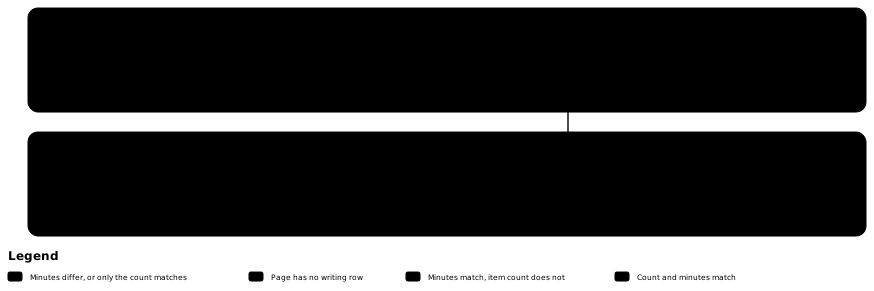
Each node is one English page set beside the sample writing row. Do not merge the two documents.
Score lines on the English pages belong to the papers those pages describe. They are not printed on the 3.0 sample covers or on the sample answer keys read here. The format post records which page prints which score line. This page does not move those lines onto the samples.
What a recognition check can tell you
The lists, the sample tasks, and Chinese Copilot's test answer different questions.
The word lists linked above are the 2025 vocabulary entries. The samples are the timed writing tasks, from Level 2 onward. Chinese Copilot's free HSK 3.0 level test is a recognition estimate: 119 words drawn fresh each run, 17 from each of Levels 1 to 6 and 17 from the combined Levels 7-9 list. You mark whether you recognize the word. There is no account. Answers stay in the browser. It typically takes 5-10 minutes. The result is an approximate level from 1 to 6, or the combined HSK 7-9 range, plus a stage: Elementary (初等), Intermediate (中等), or Advanced (高等).
The test does not include the writing items on these samples. It does not ask you to choose a component, handwrite a character, finish a sentence, or write an essay. It does not produce a writing score, and it does not predict a result on the sample tasks. The word source and the thresholds are on the methodology page.
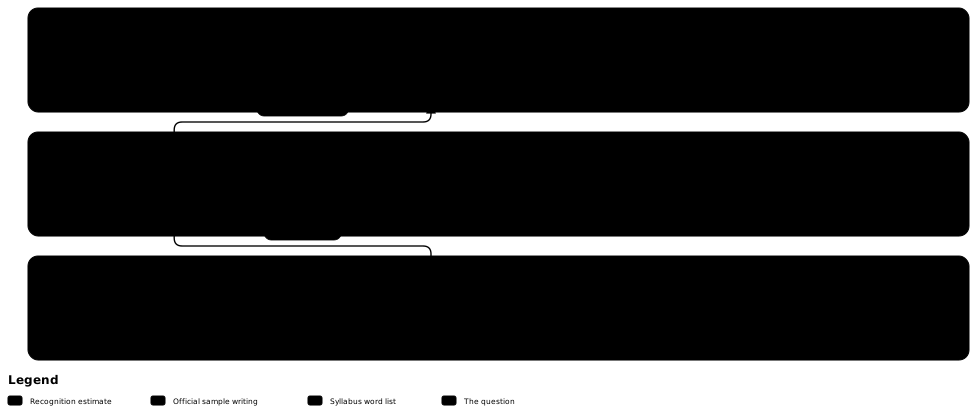
The test marks known words. The samples are where the writing tasks actually are. One result is not the other.
If you want the task, open the sample for that level and the level guide linked above. If you want the characters the syllabus lists for handwriting, use the 书写字 headings, and remember that Level 1 shares the list of 100 with Level 2 while the Level 1 paper never reaches a writing section. If you want an approximate recognition level, use the test, and read the result as recognition only.
More on the new exam, level by level, is in our HSK 3.0 guide.
Sources
- HSK overview: About the New HSK, CTI Co., Ltd., chinesetest.cn. Links the sample ZIP under the download name HSK3.0考试样题.zip. The overview does not print the writing item ranges.
- Sample papers in that ZIP, compiled by the Center for Language Education and Cooperation:
HSK/HSK(一级)样卷.pdfthroughHSK/HSK(六级)样卷.pdf, the Levels 7-9 written paper, and the matching样卷答案.pdffiles. Covers, task lines, and keys as quoted above. No writing rubric and no pass mark on those keys. This site does not host the PDFs. The dash in the Levels 7-9 file name is documented on the sample-papers page. - Syllabus for the Chinese Proficiency Test (HSK), Center for Language Education and Cooperation, cover 2025-11 发布 and 2026-07 实施. Handwriting lists as tabulated above. The sums 100, 250, 400, 550, 700, and 1,200 are addition, not printed headings.
- HSK (Level 2), Level 3, Level 4, Level 5, Level 6, and Levels 7-9, chinesetest.cn, read 20 October 2026. Writing rows for the papers those pages describe: no writing row at Level 2, 5 + 5 in 15 minutes at Level 3, 10 + 5 in 25 minutes at Level 4, 8 + 2 in 40 minutes at Level 5, 1 item in 45 minutes at Level 6, and 1 + 1 in 55 minutes at Levels 7-9.
- Hanyu Shuiping Kaoshi, English Wikipedia, read 20 October 2026. Secondary overview. Its 2025 table prints Level 1 writing characters as 0 and a cumulative 1,200. That is not the syllabus heading.
- Chinese characters, English Wikipedia, read 20 October 2026. Secondary overview beside the first use of "Chinese characters." The 字 counts in this post come from the sample items.
- Zizzle, HSK 3.0 guide, third party, read 20 October 2026. Writing as a column, a Level 3 "picture-prompted" line the sample does not match, and cumulative handwriting counts including a Level 1 zero.
- Shangke, HSK 3.0, third party, read 20 October 2026. Levels 2 and 3 grouped as filling a character. The writing note stops at 80 characters.
- PrepEdu, HSK structure, third party, read 20 October 2026. Character writing starts at HSK 2. Not an item-range walk-through.
- Pass HSK, HSK 3 requirements, third party, read 20 October 2026. Level 3 communicative tasks, and a cumulative 250 that is not a syllabus heading.
- Vision Chinese, HSK writing guide, third party, read 20 October 2026. The page says it covers the paper before the December 2026 change.