Chinese Characters vs Words: What to Count
Should you count hanzi or words? How 字 and 词 differ, how HSK lists count each, and why knowing a character doesn't mean you know the words built from it.
By Chinese CopilotLast reviewed ≈7 min read
On this page
"I know 800 characters" and "I know 800 words" sound like the same boast. In Chinese they are different claims, and mixing them up makes it hard to compare your progress with a course, an app, or an HSK level. This post explains the difference between a character and a word, how the official HSK documents count each one, and what is worth tracking.
字 and 词: two different units
A character (字, zì) is one written symbol, like 电 or 脑. In Mandarin a character is almost always read as one syllable.
A word (词, cí) is a unit of meaning, and it can be one character or several. 电脑 (computer) is one word written with two characters. 打电话 (make a phone call) takes three.
Even the vocabulary for talking about this follows the pattern. In the 2025 HSK exam syllabus word list, 字 and 汉字 (Chinese character) are Level 1 words and 词 is a Level 2 word.
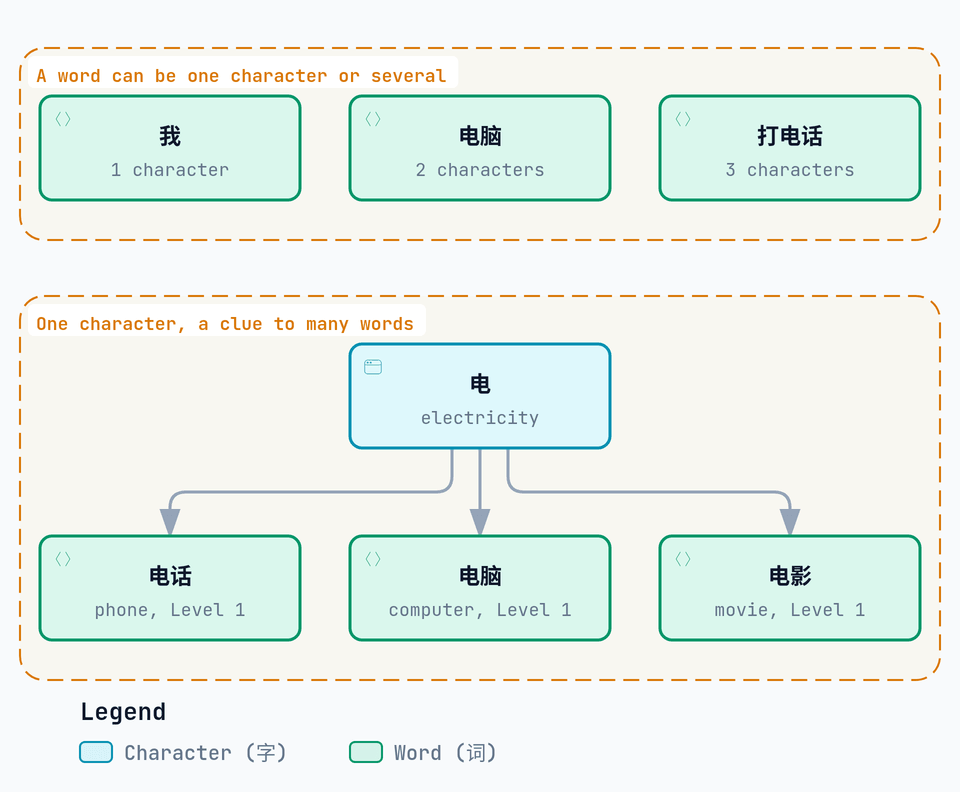
Examples from this post. A character you can read is a head start on a word, not the word itself.
Most Chinese words have more than one character
Single characters dominate the first page of a textbook: 我, 你, 好, 是. But they are a minority of the vocabulary. We counted the word list of the 2025 HSK exam syllabus, published by the Center for Language Education and Cooperation (CLEC), which the new nine-level exam follows:
| Level | New entries | One character | Two or more characters | Share with 2+ characters |
|---|---|---|---|---|
| 1 | 300 | 137 | 163 | 54% |
| 2 | 200 | 84 | 116 | 58% |
| 3 | 500 | 134 | 366 | 73% |
| 4 | 1,000 | 210 | 790 | 79% |
| 5 | 1,600 | 266 | 1,334 | 83% |
| 6 | 1,800 | 252 | 1,548 | 86% |
| 7–9 | 5,600 | 512 | 5,088 | 91% |
| All | 11,000 | 1,595 | 9,405 | 86% |
Counted from the syllabus's numbered word list (list entries, not unique word forms; a few forms appear twice with different readings). Our count, not a figure printed in the syllabus.
Even at Level 1, more than half the entries are written with two or more characters, and the share rises at every level. So "how many characters do I know?" and "how many words do I know?" drift further apart the further you go.
How the HSK documents count
HSK 2.0 counts words. The six-level exam launched in 2009 gave one vocabulary target per level, in words, in its official introduction. Chinese Vocabulary Size vs HSK Level puts those counts next to the nine-level ones.
The GF 0025-2021 standard counts both. The national standard Chinese Proficiency Grading Standards for International Chinese Language Education, published in 2021 by China's Ministry of Education and State Language Commission, grades learners on four benchmarks: syllables, characters, words and grammar. Its totals are 3,000 characters and 11,092 words (MOE Q&A, in Chinese). Its quantitative table adds 300 characters at each of Levels 1–6, for 1,800 by Level 6, and says learners finishing the elementary stage (Levels 1–3) should be able to write 300 characters by hand (standard PDF, pp. 1–2).
The 2025 exam syllabus lists characters to read and characters to write. CTI Co., Ltd. (CTI), which organizes the HSK, says on its HSK page that the new syllabus covers tasks, topics, vocabulary, grammar and Chinese characters. The character part has two sets of lists: characters to recognize (认读字) and characters to write (书写字). Counting the numbered entries, we get:
| Level | New characters to recognize | Cumulative to recognize | New characters to write |
|---|---|---|---|
| 1 | 246 | 246 | 100 (Levels 1–2 together) |
| 2 | 125 | 371 | (included above) |
| 3 | 284 | 655 | 150 |
| 4 | 441 | 1,096 | 150 |
| 5 | 431 | 1,527 | 150 |
| 6 | 413 | 1,940 | 150 |
| 7–9 | 1,148 | 3,088 | 500 |
By Level 6 that is 700 characters to write, and the Levels 7–9 list adds 500 more. Every character on a writing list also appears on a recognition list. The syllabus expects you to read far more characters than you write.
The two counts are tied together. When we compared the lists, the characters used in the syllabus's Level 1–3 words were exactly the 655 characters on the Level 1–3 recognition lists, and the same was true for Levels 1–6 (1,940 characters). In other words, the recognition lists are the characters you meet by learning the words. Learn the words and the reading characters come with them.
The two nine-level documents differ from each other here too, as they do for words. If you prepare for the new exam, use the syllabus lists.
Knowing the characters doesn't mean knowing the word
A compound's meaning is often not the sum of its characters:
- 东西 (dōngxi, thing) is written "east" + "west." The syllabus lists 东西 as a Level 1 word and 东 and 西 as separate words only at Level 3.
- 马上 (mǎshàng, right away, Level 3) is "horse" + "on." 小心 (xiǎoxīn, careful, Level 3) is "small" + "heart."
- The same two characters can be two different words. 地道 is dìdao (authentic) at Level 6 and dìdào (tunnel) at Levels 7–9. 地方 is dìfang (place) at Level 3 and dìfāng (local) at Level 6.
- In loanwords the characters mostly stand for sounds. 咖啡 (coffee, Level 2), 沙发 (sofa, Level 3) and 巧克力 (chocolate, Level 4) tell you little through their parts.
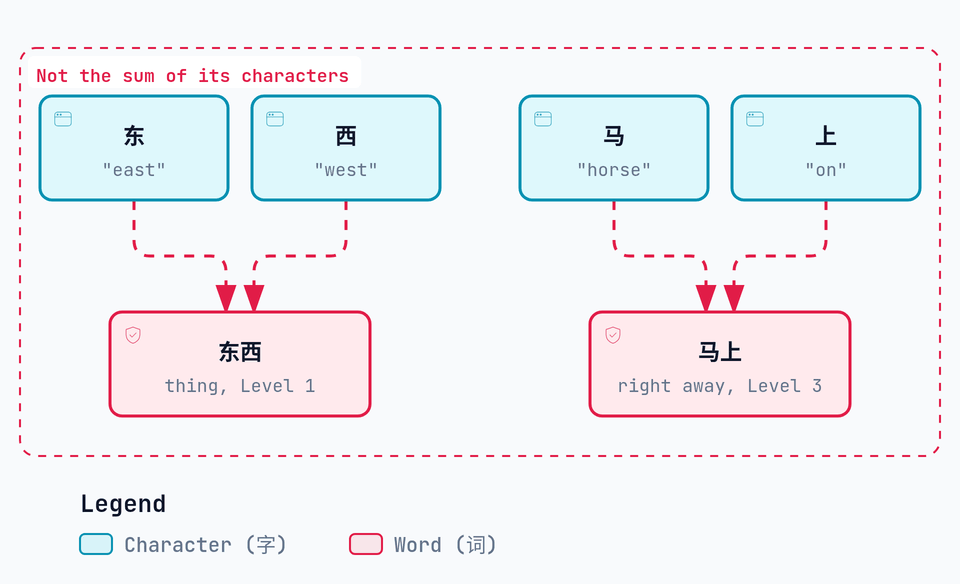
Two examples from the list above. The red boxes are words whose meaning you can't get by adding up their characters.
Characters do help. If you know 电 (electricity), you already have a clue to 电话 (phone), 电脑 (computer) and 电影 (movie), all Level 1 words. But a character you can read is a head start on a word, not the word itself.
Knowing a word doesn't mean knowing its characters
The reverse gap is just as real. Plenty of learners pick up words by ear or through pinyin before they can read them. You might say 咖啡 every day and still not recognize 咖 and 啡 on a menu. Writing is a further step: 咖 and 啡 are on the syllabus's Level 2 recognition list but on none of its writing lists.
This matters for how you take a recognition test. Our placement tests show each word in characters with pinyin turned on by default. With pinyin showing, you can recognize a word you know by sound without reading its characters. If you want to know whether you can read the characters, switch pinyin off with the checkbox at the top of the test.
What this site's tests count
Both tests count words, not characters. Each card is one word from a word list, and the rough size figure on the results page is a count of words (list entries for the HSK 3.0 test), not characters. The HSK 2.0 test draws from the HSK 2.0 word lists, plus a small sample from the GF 0025-2021 standard's Levels 7–9 list. The HSK 3.0 test draws from the word list of the 2025 HSK exam syllabus and leaves out items of four or more characters, among other filters. Neither test checks whether you could write a character. The methodology page has the full word sources and filters, and terms such as band are in the methodology glossary.
What to track in practice
- Use words as your main count. HSK levels, textbooks and our tests are organized by words. "About 400 of the 500 new Level 3 words" is easy to check against a syllabus.
- Check characters as a reading test. Go through the recognition list for your level and mark characters you can't read inside a word. Each one points to words you should review.
- Track writing separately, and smaller. If handwriting matters to you, work from a writing list, like the syllabus's 书写字 lists, instead of trying to write everything you can read.
- Learn each new character inside two or three words. Take them from your level's word list, so the character and its common compounds reinforce each other.
- Keep a list of compounds that surprised you. Words like 东西 and 马上 are the ones a character-by-character guess gets wrong.
- Name the unit and the list when you compare numbers. "1,500 characters" and "1,500 words" are different claims, and so are counts from two different word lists.
For turning the words you recognize into ones you can say and write, see Passive vs Active Chinese Vocabulary. For what an HSK level covers beyond vocabulary, see What Does an HSK Level Really Mean?.
Short FAQ
How many characters do I need for HSK 4? It depends on the framework. The 2025 syllabus lists 1,096 characters to recognize by Level 4, by our count, and the six-level exam's introduction gives only word targets. Check which exam version your sitting uses.
Is it faster to learn characters first? The syllabus data suggests the two go together: the characters on its recognition lists are the ones used in its words. Learning words, and noticing the characters inside them, covers both.
Does the placement test measure characters? No. It asks whether you understand a word. With pinyin off, it gets closer to a reading check, but it still counts words.
Next step
Take the free HSK 2.0 Placement Test or the HSK 3.0 version with pinyin off to see how many words you can read from characters alone.
Sources
- Syllabus for the Chinese Proficiency Test (HSK), Center for Language Education and Cooperation, 2025 (PDF, in Chinese): word list and character outline (HSK 汉字大纲, printed pp. 352–381); counts in this post are ours
- HSK overview, CTI Co., Ltd. (chinesetest.cn)
- Ministry of Education Q&A on GF 0025-2021 (in Chinese) and the standard itself (PDF, quantitative table and elementary-stage description on pp. 1–2)
- Introduction to the new HSK (2009), chinesetest.cn
- How the tests work, Chinese Copilot methodology