Passive vs Active Chinese Vocabulary
Why you recognize more Chinese words than you can say or write, what our placement tests measure, and practical ways to turn known words into usable ones.
By Chinese CopilotLast reviewed ≈8 min read
On this page
You see 解决 in a sentence and know at once that it means "solve." An hour later you want to say "I solved the problem," and the word isn't there. That gap is normal. Recognizing a word and being able to use it are two different kinds of knowledge, and they grow at different speeds. This post explains the difference, what our placement tests actually measure, and how to move words from the first kind to the second.
Two directions of knowing a word
Researchers often call the two directions receptive and productive knowledge. Learners usually say passive and active.
- Receptive (passive): you meet the Chinese word, in print or in speech, and get to its meaning.
- Productive (active): you start from a meaning and have to come up with the Chinese word yourself, in speech or in writing.
What Does an HSK Level Really Mean? introduces this split in the context of HSK levels. Here the focus is on what it means for a single word.
In Chinese, the productive direction asks for more pieces. To recognize a word, you need to connect its characters (or its sound) to a meaning, with some help from context. To use it, you also need to:
- recall the word with no prompt at all
- say the tones clearly enough for a listener
- write the characters, by hand or by picking the right one from a pinyin keyboard
- know its measure word and the words it usually goes with
- know where it fits in a sentence
Any one of those pieces can fail while recognition still works fine. That is why "I know this word" can be true on a flashcard and false in a conversation.
Why your passive vocabulary is bigger
A study by Stuart Webb in Studies in Second Language Acquisition (Webb, 2008) tested learners of English with matching receptive and productive tests. With strict scoring, receptive vocabulary was larger than productive vocabulary, and the gap grew as words became less frequent. With partial-credit scoring the two sizes were close. Learners with larger receptive vocabularies also tended to know more words productively.
In plain terms: the rarer the word, the more likely it is that you can understand it without being able to produce it. A fuzzy memory is often enough to recognize a word in context, but not enough to recall it on demand. The study was on learners of English, so read it as a general pattern, not a Chinese-specific figure.
What our placement tests measure
Both free tests on this site, the HSK 2.0 Placement Test and the HSK 3.0 Placement Test, measure the receptive side only. Here is exactly what happens on each card:
- You see a word in simplified characters. Pinyin is shown by default, and a Pinyin checkbox at the top lets you hide it.
- Under the word is the question "Know it well enough to understand in context?" and two buttons: Know and Don't know.
- The test never shows a meaning and never checks one. There is no audio, no typing, and no writing. The answer is your own judgment.
The HSK 2.0 test shows the same 120 words every run. The HSK 3.0 test draws 119 words each run from the word list of the 2025 HSK exam syllabus. Words you skip count as unknown. The methodology page lists what the tests don't measure, and terms such as band are defined in the methodology glossary.
So a result like "about HSK 4" means: across the sampled words, you say you can understand them in context about as well as someone working around HSK 4. It says nothing about which of those words you can say or write.
Two ways to get more out of the test with this in mind:
- Turn pinyin off if you want to know whether you can read the characters, not just recognize a word you know by sound.
- Keep your "Know" standard strict. If you would need a second or two and some luck to get the meaning, click "Don't know." The prompt itself warns that guessing inflates your level.
Turning recognized words into usable ones
The good news is that the productive side can be trained directly. None of the methods below is exotic. They all make you produce the word instead of just looking at it.
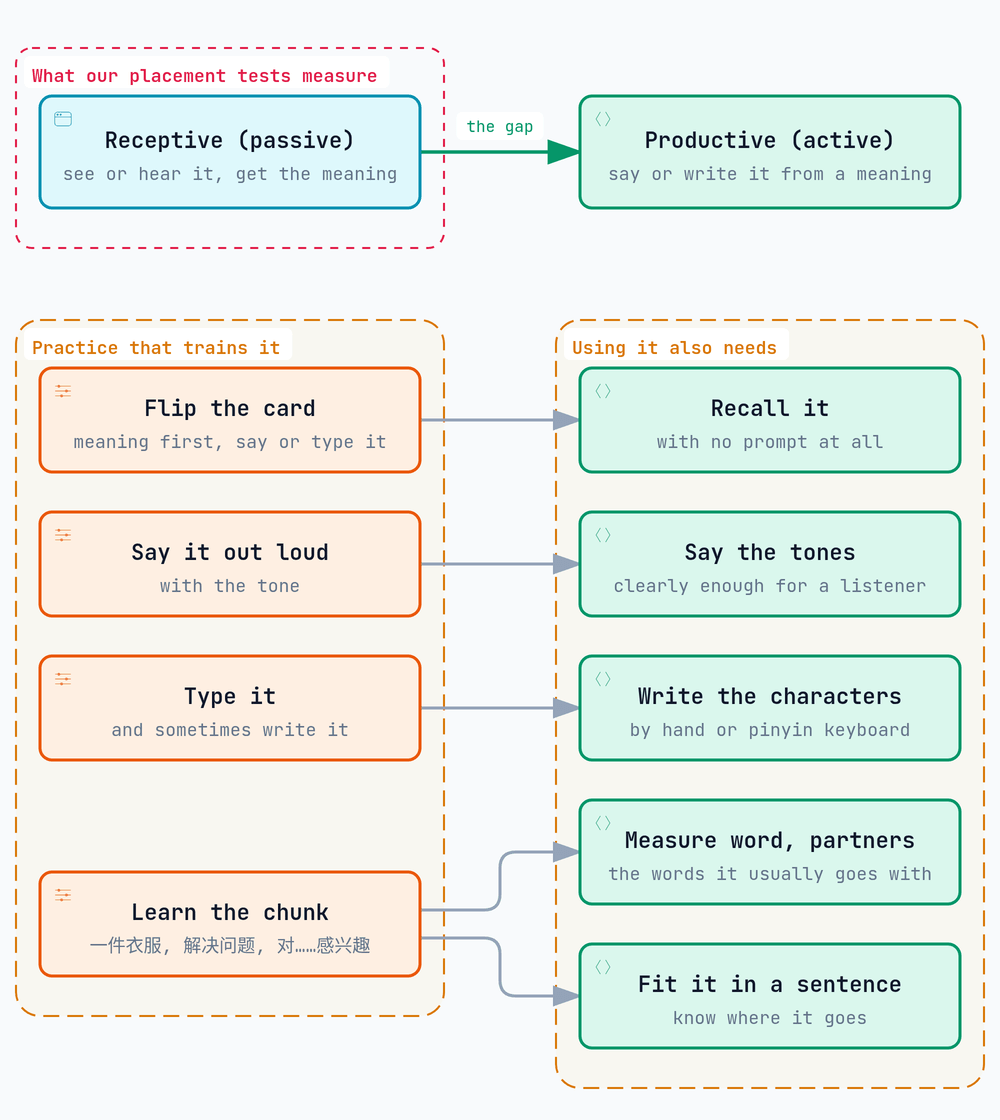
How the pieces in this post fit together. Two methods are left out because they aren't tied to one piece: spacing the reviews and giving every new word a job.
1. Flip the card direction
Most flashcard decks show Chinese first and ask for the meaning. That trains recognition. For words you want to use, make the prompt the English meaning (or a picture, or a sentence with a gap) and make yourself say or type the Chinese before you look.
This is retrieval practice: pulling an answer out of memory instead of rereading it. In a well-known experiment on foreign-language vocabulary, repeated testing after students had learned the words produced much better recall a week later, while repeated studying added nothing (Karpicke & Roediger, 2008). A later study that compared the two directions found that productive learning of word pairs led to larger gains in several kinds of word knowledge, including productive knowledge of meaning and grammatical use; receptive learning did better only for receptive knowledge of meaning (Webb, 2009).
2. Space the reviews
Review a word again after a gap, then after a longer gap, instead of drilling it many times in one sitting. A large review of study techniques rated both practice testing and spreading practice out over time as "high utility," because they helped learners of many ages and ability levels across many kinds of material (Dunlosky et al., 2013). Spaced-repetition apps build this schedule for you. Just make sure the cards are in the productive direction for the words you want to use.
3. Learn the chunk, not the bare word
A word you can use comes with its partners. When you add a word to your active list, add the phrase you would actually say:
- Measure words. The 2025 syllabus word list tags 个, 本, 件 and 只 as measure words at Level 1. Learn 一件衣服 and 一本书 as units, not 衣服 and 书 alone.
- Collocations. 解决问题 (solve a problem), 提高水平 (raise your level), 打电话 (make a phone call). The syllabus even lists 打电话 as its own Level 1 entry.
- Frames. 对……感兴趣 (be interested in...) is only usable if you know where 对 goes.
4. Say it out loud, with the tone
Recognition often survives a wrong tone. A listener may not. 买 (mǎi, buy) and 卖 (mài, sell) are both Level 1 words in the syllabus and differ only in tone. When you review a word productively, say it aloud, and now and then record yourself and compare with a dictionary recording.
5. Type it, and sometimes write it
Pinyin input looks easy until you have to choose between homophones. 坐 (sit) and 做 (do, make) are both zuò and both Level 1 words. Typing a sentence forces you to pick the right one, which is a small production test in itself. If handwriting matters for your goals or your exam, practice it separately. Chinese Characters vs Words explains how the new HSK syllabus lists characters to read and characters to write.
6. Give every new word a job
Words stick in the active list when you use them for something:
- Write three sentences a day that each use one target word, about your own life.
- Retell a paragraph from a graded reader without looking at it, then check which words you avoided.
- Before a lesson or language exchange, pick five words you want to use and tick them off as you do.
- Describe what you did today out loud, in two minutes, and note where you got stuck.
The words you get stuck on are your next productive flashcards.
A simple way to check your active vocabulary
Our tests can't show you this, but you can check it yourself in ten minutes:
- Take 20 words from your current level's list that you would click "Know" on.
- Cover the Chinese. For each English meaning, say the word and type it.
- Count the words you got right with the correct tones and characters.
The difference between 20 and your score is your passive-only set. Move those words into a productive deck and check again after a few weeks. For combining a recognition result with timed papers and graded reading, see How to Estimate Your HSK Level. For deciding which level's words to study next, see How to Read Your HSK Placement Result.
Short FAQ
Is passive vocabulary useless? No. You need it for reading and listening, and it is where most words start. The aim is to move the words you need for speaking and writing into the active set, not to stop building recognition.
Should every word become active? Not at the same time. Words you meet often and want to say are worth the effort first. Rare words can stay receptive for a long time.
Can the placement test tell me my active vocabulary? No. It asks whether you understand a word when you see it. Speaking and writing need a different kind of check, like the ten-minute one above.
Next step
Take the free HSK 2.0 Placement Test (or the HSK 3.0 version) with pinyin off and a strict "Know" standard. Then run the ten-minute check on words from your level to see how much of that recognition you can already use.
Sources
- Receptive and productive vocabulary sizes of L2 learners, Stuart Webb, Studies in Second Language Acquisition 30(1), 2008
- The effects of receptive and productive learning of word pairs on vocabulary knowledge, Stuart Webb, RELC Journal 40(3), 2009 (ERIC record)
- The critical importance of retrieval for learning, Jeffrey D. Karpicke and Henry L. Roediger III, Science 319, 2008
- Improving students' learning with effective learning techniques, John Dunlosky et al., Psychological Science in the Public Interest, 2013 (APS summary)
- Syllabus for the Chinese Proficiency Test (HSK), Center for Language Education and Cooperation, 2025 (PDF, in Chinese; linked from chinesetest.cn): word list entries, levels, and parts of speech used for the examples
- How the tests work, Chinese Copilot methodology